
What Are the Different Types of App Development Companies?

December 28, 2022

When choosing an app development company for your project, there’s quite a few types of companies you can select from. You can pick a local software development company, a company on the other side of the world, or something in between. App development can be a costly investment, so you may want to do your research to pick the best app development company for your business, organization, or institution. We’re going to discuss the different types of app development companies and some pros and cons of each so you can make an informed decision when you’re ready to choose a developer for your app development project.

The types of software development companies we’re going to discuss are as follows:

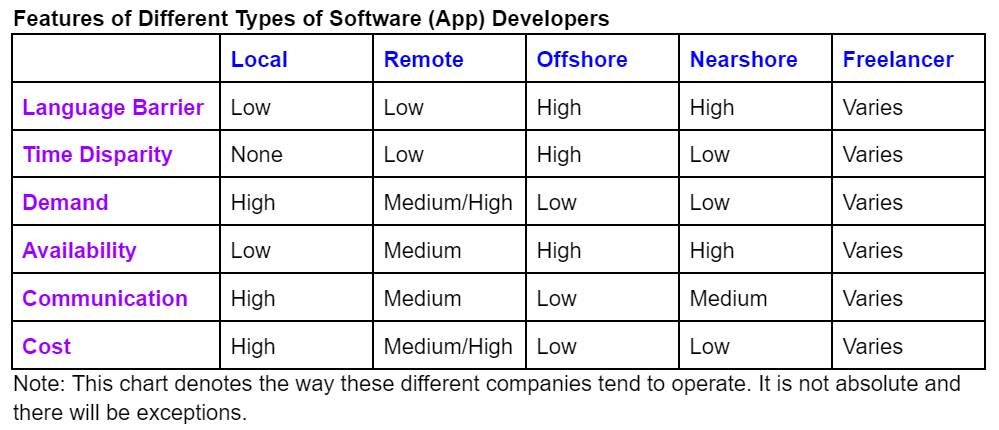
Keep in mind that we’re going to describe and compare how these different types of app development companies tend to be,  and this comparison is not absolute. You can also look at this chart for a side-by-side comparison:
Onshore Development

With onshore development companies, the developers live and work within the United States, though not necessarily in the same state or  location as the product owner. With onshore development, the developer and the product owner live within a few time zones of each other and can usually communicate without time differences being a major factor. Both the developer and the product owner are often native English speakers so language tends to not be as much of a barrier. Due to these factors, onshore developers are often in higher demand. They also tend to charge a more premium price than development companies who reside in locations outside of the United States, though that will differ from company to company. It is worth noting that some onshore development companies outsource some of their work to offshore or nearshore developers to keep their costs down. If that is a concern, then you may want to ask your prospective developer about their outsourcing practices prior to hiring them. There are two different types of onshore development companies: remote development companies and local development companies.

Local Development Companies

Local development companies offer app development in the same locale as the product owner, which can lead to one-on-one, in-person meetings and discussions that might be easier to coordinate. Because of this, local development companies are often in very high demand. There may be a waiting list for your initial consultation, they may be difficult to initially talk to, and may be selective in the projects they accept. Because of their high demand and the ease in communications to discuss individual projects, including one-on-one meetings, once a project is taken on, they also tend to charge premium prices for their services.

To summarize, local development companies offer the following:
Language Barriers  – Language barriers can exist, but there tends to be fewer problems.
Time Disparity – Both product owner and developer are within the same time zone.
Demand – Tends to be in the highest demand.
Availability – Initial contact may be difficult to achieve, they may have a waiting list, and they may be more selective in the projects they take.
Communication – Regular one-on-one, in person meetings can be coordinated and scheduled. Cost – Tends to charge a premium price for their services.

Remote Development Companies

Remote development companies have their business operations within the United States but are not in the same location as the product owner. They could be located on the other side of the country. This can lead to problems with availability, and all meetings would probably need to be conducted over the phone or through an online portal like Zoom. Due to these two factors, meetings could sometimes be difficult to coordinate. Remote development companies tend to be in demand but in not much demand as local companies. They also tend to charge more than some options though possibly not as much as a local development company.

To summarize, remote development companies offer the following:
Language Barriers –  Language barriers can exist, but there tends to be fewer problems.
Time Disparity – No more than a few hours difference in time.
Demand – They tend to charge a more premium price than offshore and nearshore companies. Availability – They may be less available to take on projects than offshore or nearshore companies.
Communication – Remote development companies tend to rely on online communication platforms and phone calls and may sometimes have problems with coordinating meetings.
Cost – Tends to charge a more premium price for their services which is often based on demand.

Offshore Development Companies

Offshore developers are developers who are not located in the United States and often reside and conduct operations from countries such as India, China, or the Philippines. Offshore developers, in most cases, are just as qualified as onshore developers, but communication can sometimes be difficult when hiring an offshore developer. There are several reasons for this. Time zones are totally different between the product owner and the developer, so it may be difficult to arrange meetings and meetings can be at unusual times. In many cases, a language or idea barrier may also exist. With offshore developers, English is often the developer’s second language. Due to this, there may be words they are unfamiliar with or their accent might be difficult to understand. This language barrier can work both ways; they may not understand you either. Also, their culture may be totally different than what is the norm in the United States which can lead to their not understanding requests. This can sometimes cause unforeseen issues. Offshore developers tend to request a less premium price than a developer who lives and works in the United States, but price is determined by the developer and that is not always the case. There also tends to be less demand for offshore developers most of the time so they tend to be readily available to take on new projects.

To summarize, offshore development companies offer the following:
Language Barriers – A mutual language and idea barrier may exist between the app founder and an offshore developer due to English not being the developers’ native language, or they may have a difficult to decipher accent. This communication barrier can go both ways.
Time Disparity – Often live in totally different time zones with a 10-15 hour difference in time. Demand – Tends to be in lowest demand so they are often easy to acquire.
Availability – Tends to be readily available to take on new projects.
Communication – Meetings may be difficult to arrange and may occur at awkward times. Cost – Often charges a less premium price for their services.

Nearshore Development Companies

A nearshore developer is a developer who lives and operates from a foreign company but within a few time zones of the product owner. In the United States, nearshore developers usually operate from Mexico or South America though Canada would also be considered nearshore. Being just a time zone or two away from the developer allows for easier communication since the working hours of the developer and product owner are similar, but there could be significant language barriers between the software developer and the product owner because English may not be the developer’s native language or they may have an accent that is difficult to understand. Nearshore developers tend to charge a less premium price and be in less demand than onshore or local development companies.

To summarize, nearshore development companies offer the following:
Language Barriers – Except for Canada in some cases, English is usually not the developers’ native language, so definite barriers can exist.
Time Disparity – No more than a few hours’ difference in time.
Availability – Tends to be available to take on new projects.
Communication – Remote development companies tend to rely on online communication platforms and phone calls and may sometimes have problems with coordinating meetings.
Cost – Tends to charge a less premium price than onshore developers.
Demand – Tends to be in less demand than local or remote developers.

Freelance Developers

Software development freelancers can be located in the local area or found anywhere within the United States or even abroad. Their availability for meetings with product owners, whether those meetings are in person or via Zoom, can vary depending on the amount of clients the developer has and what office hours they choose to keep. Their price can also vary widely depending on their knowledge, experience level, and location. Freelance developers, due to being single entities and lacking a team, sometimes do not possess the knowledge to complete a software project as specified. Freelancers may also lack the means to test a product thoroughly before it is launched. Due to these factors, a freelancer may sometimes abandon a project before completion or the project is delivered incomplete.

Each freelance developer is different so they can fit anywhere within the spectrum of the others. The biggest thing to note, however, is that they may not have the knowledge or skills to complete the job they were hired for.


We hope that this information helps you find the right software developer for your unique project and circumstances. Matraex is an app development located in Boise, Idaho, and we would provide the app development answers that you need so you can be an informed consumer. Check out Matraex’s other blogs for answers to other questions you may have. Ones that may be of particular interest to you include “How Much Does a Custom App Cost?” and “What Are Problems that Occur When Developing an App?” Can’t find an answer to your question? Contact us directly or give us a ring at (208) 344-1115. Your question may even become an upcoming blog.

Sign up to receive answers to your questions delivered directly to your inbox!